Daavlin Aquex iontophoresis in Fergana and Kokand
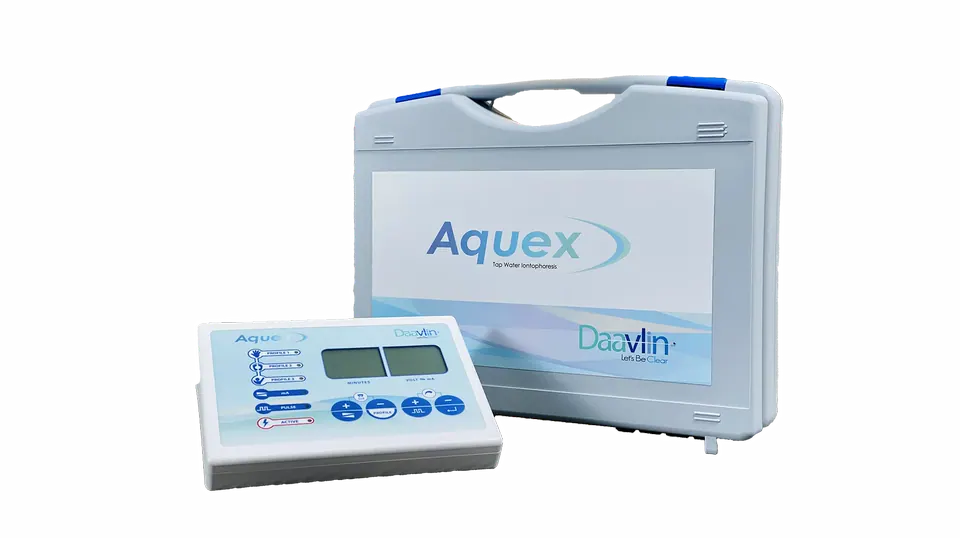
Daavlin Aquex — iontophoresis device for transdermal drug delivery.
Daavlin Aquex delivers medications into the skin via iontophoresis. It supports local treatment of skin conditions, hydration and deep delivery of prescribed agents. At Radeski Clinic it is used under dermatologist supervision with individualized protocols.
Iontophoresis uses a weak direct electric current to carry charged medicinal substances through the skin into the tissues. Daavlin Aquex is an iontophoresis device made by Daavlin (USA) and used in dermatology to support local treatment.
The skin acts as a barrier that protects the body from the outside world, so many substances in ointments and creams do not penetrate deeply. Iontophoresis can help some substances pass through this barrier. That is why it is used as an additional method in the local treatment of skin conditions, for hydrating and restoring the skin, and for delivering medicines prescribed by the doctor.
At Radeski, Aquex iontophoresis is carried out under a dermatologist's supervision according to an individual protocol. Before treatment, the doctor examines your skin, clarifies the diagnosis and decides which preparation, which area and how many sessions are needed.
Manufacturer: Daavlin (USA)
How does it work?
During the procedure, electrodes are placed on the skin, usually in contact with it through pads soaked in a solution of the preparation or in water. The device produces a weak direct current, and charged particles are pushed away from the electrode with the same charge and into the skin. The current is increased gradually and monitored throughout the session.
Only the doctor decides which substance to use and at what concentration. Not every preparation is suitable for iontophoresis: it must carry an electric charge and be approved for use with this method.
- Helping some preparations pass through the skin barrier
- Support for local dermatological treatment
- Better skin hydration and comfort
- Delivering a preparation to a specific area
Indications
Dry and dehydrated skin
If your skin is dry, tight and flaky, iontophoresis can support the effect of moisturising and restorative products. The first step is to find the cause of the dryness, which may be linked to skincare habits, climate or a skin condition.
Local treatment of skin conditions
In some skin conditions, iontophoresis can be used to deliver a prescribed preparation directly to the affected area. It does not replace the main treatment but is used alongside it.
Therapy with prescribed preparations
The choice of preparation depends on the diagnosis, the area and your individual characteristics. The doctor takes any history of allergic reactions into account and chooses only products that are suitable for iontophoresis.
Recovery and care protocols
Iontophoresis may be included in a comprehensive plan to support skin recovery after other dermatological or aesthetic procedures. The doctor decides the order of procedures and the intervals between them.
Who is it for?
Aquex iontophoresis may suit patients who need local treatment or skin recovery and have no contraindications to electric current. Before the procedure, the doctor assesses:
- The diagnosis and skin condition, including any wounds or cracks in the area
- Any pacemaker or other implanted electronic device
- Metal implants in the treatment area
- Allergies to medicines
- Chronic illnesses and current medications
Contraindications
Whether iontophoresis is possible is decided individually. The main reasons to postpone or avoid it are:
- A pacemaker, defibrillator or other implanted electronic device
- Metal implants in the path of the current
- Pregnancy
- Epilepsy and certain heart rhythm disorders
- Open wounds, deep cracks or a skin infection in the treatment area
- Allergy or hypersensitivity to the preparation being used
- Fever and acute infections
- Unexamined suspicious lesions in the treatment area
Risks are assessed separately in people with reduced skin sensation, people with diabetes and children. Small cuts may be covered with a protective product before the session. The doctor makes the final decision.
How we use it at Radeski Clinic
Session length and preparation depend on the condition. Book a consultation for exact pricing and plan.
Procedure steps
- Consultation: The dermatologist examines your skin and asks about your complaints, medical history, allergies and any implanted devices. The preparation, area and session plan are then decided.
- Skin preparation: The treatment area is cleaned and rings, bracelets and other metal jewellery are removed. Any small cuts or scratches are covered with a protective product.
- The iontophoresis session: The electrodes are placed on the skin over moistened pads and the current is increased gradually. You may feel mild tingling or prickling. If the discomfort gets stronger, tell the staff straight away and the current will be reduced.
- Aftercare: After the session there may be temporary redness or mild dryness where the electrodes were placed; this usually settles on its own. The doctor will explain how to care for your skin and when the next session will be.
Results: what to expect
The outcome of iontophoresis depends on its purpose, the preparation used and the condition of the skin. The effect builds gradually and is not guaranteed. During a course you may see:
- Less dryness and tightness
- Less local inflammation and discomfort
- A better response to the main local treatment
- Support for skin recovery
Frequently asked questions
Is iontophoresis painful?
Usually not. During the session you may feel mild tingling or prickling. The current is increased gradually and turned down straight away if the discomfort grows. There may be temporary redness where the electrode was afterwards.
How many sessions are needed?
The number of sessions depends on the goal, the preparation and the condition of the skin. A course is usually recommended, and in some cases maintenance sessions are needed afterwards to keep the result. The doctor sets the exact plan.
Is the electric current dangerous?
Iontophoresis uses a weak direct current whose strength is monitored throughout the session. The main risks relate to implanted electronic devices, metal implants in the path of the current and damaged skin, so tell the doctor about these beforehand.
Is iontophoresis safe for children?
Iontophoresis is used in children in some cases, but the decision is made with particular care: the current, the preparation and the session length are adjusted for age. It is important that the child can describe how it feels. Only a dermatologist can decide whether the method is suitable for a child.
Conclusion
Daavlin Aquex iontophoresis uses a weak electric current to deliver prescribed preparations into the skin and support local dermatological treatment. It does not replace the main treatment but is used as part of a comprehensive plan.
At Radeski, iontophoresis is carried out after a dermatologist examination, following an individual protocol. The doctor will explain whether the method suits you, which preparation will be used and how the course is planned.