DEKA CO₂ Laser SmartXide Punto in Fergana and Kokand
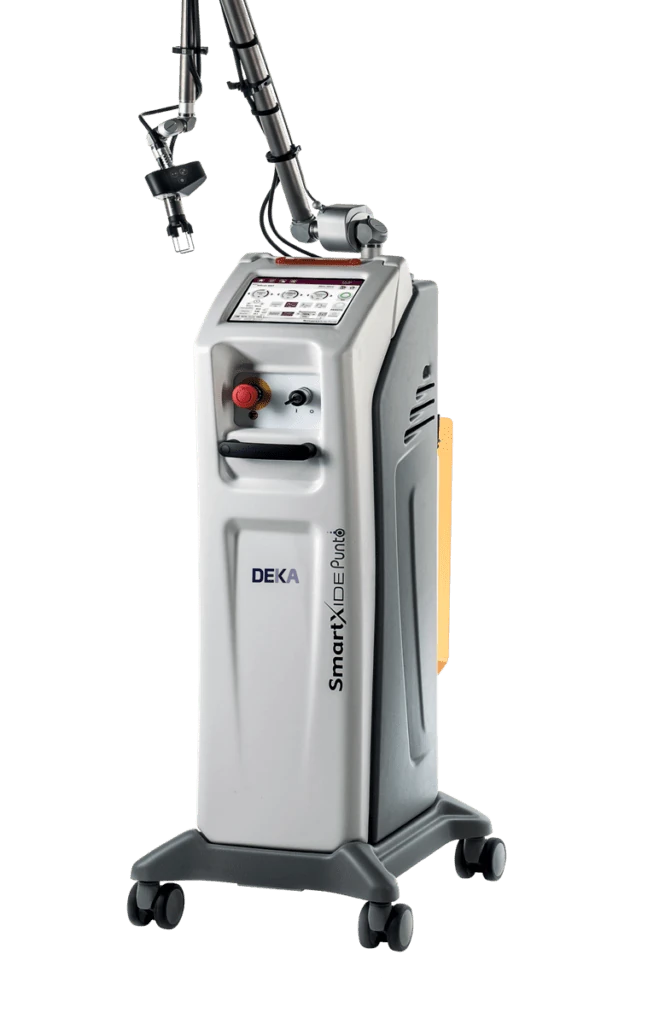
Fractional CO₂ laser — skin renewal, post-acne scars and PinPoint mode.
DEKA SmartXide Punto CO₂ at Radeski Skin Clinic stimulates collagen renewal through fractional micro-zones, smooths texture and removes benign lesions when indicated. PinPoint mode supports warts and papillomas with minimal trauma. At Fergana and Kokand branches, energy, depth and treatment field are set individually by a dermatologist.
The CO₂ laser is one of the most thoroughly studied ablative lasers in dermatology. Its 10,600 nm wavelength is strongly absorbed by the water in skin tissue. This lets the doctor vaporise a thin layer of skin in a controlled way and manage the depth of treatment precisely. At Radeski, the SmartXide Punto made by the Italian company DEKA is used.
The device is used in two main ways. In fractional mode the beam is split into many microscopic columns, with untouched skin left between them to speed up healing. This mode is used for skin resurfacing, post-acne scars and uneven texture. In PinPoint mode a focused beam removes warts, papillomas and other growths that a doctor has confirmed to be benign, layer by layer.
Treatment can be superficial, medium or deep. The deeper it goes, the more noticeable the effect, but the longer the recovery. The dermatologist chooses the mode and settings based on your skin type, the nature of the problem, the treatment area and how much time you can set aside for recovery.
Manufacturer: DEKA (Italy)
How does it work?
The laser energy is absorbed by water in the tissue, instantly vaporising cells and creating microscopic ablation channels. A thin zone of heat forms around each channel: it makes collagen fibres contract and starts the skin's natural repair process. Over the following months the skin produces new collagen and elastin, which is why results develop gradually.
In fractional mode only part of the skin surface is treated in one session, and the healthy tissue in between acts as a source of repair. As a result, the skin heals faster than after classic full-surface resurfacing. When removing a growth, the doctor vaporises tissue layer by layer and checks the depth visually; because the laser seals small blood vessels at the same time, bleeding is usually minimal.
- Renewal of the outer layer of the skin
- Stimulation of new collagen production
- Smoothing of atrophic scars and irregularities
- Better skin texture and less visible pores
- Fine lines becoming less noticeable
- Precise removal of benign growths with minimal bleeding
Indications
Post-acne scars
Fractional CO₂ is considered one of the main methods for treating atrophic post-acne scars. Scars usually do not disappear completely after one session, but over a course they can become shallower and less visible. Active acne needs to be brought under control first, because inflamed skin is not treated with the laser.
Other atrophic scars
Depressed scars left by chickenpox, injuries or surgery can sometimes also be improved with the laser. The doctor assesses the type, age and location of the scar. Keloid and hypertrophic scars need a different approach and are not always suitable for laser treatment.
Age-related changes and fine lines
Signs of photoaging, fine lines and some loss of firmness can be reasons for fractional resurfacing. As collagen is renewed, the skin may look denser and smoother. For deep folds and marked sagging the laser does not replace other methods, and the doctor will explain this honestly at the consultation.
Uneven texture and enlarged pores
Rough, uneven or bumpy skin can also respond well to fractional treatment. Afterwards the skin may be smoother and the pores less noticeable. The result depends on your skin type and the depth chosen.
Warts and papillomas (PinPoint)
In PinPoint mode a focused beam removes warts and papillomas with minimal effect on the surrounding skin. Because these growths are caused by a virus, new ones can appear later, and a repeat treatment is sometimes needed.
Benign skin growths
Seborrhoeic keratoses and other benign growths are removed only after the dermatologist has confirmed they are harmless. Every lesion is first examined with a dermatoscope, and a histology test is ordered when needed. If a malignant tumour is suspected, laser vaporisation is not used, because the tissue could then not be sent for examination.
Who is it for?
The CO₂ laser may suit adults who want to improve scars, skin texture or age-related changes and are prepared for a recovery period. At the consultation the doctor assesses:
- The type, depth and location of scars or growths
- Skin phototype and tendency to post-inflammatory pigmentation
- How active the acne is and current treatment, including isotretinoin
- Any history of herpes, keloid scars and how your skin heals
- Readiness for the recovery period and strict sun protection
Contraindications
Whether laser treatment is possible is decided individually. The main reasons to postpone it or choose another method are:
- An active infection in the treatment area, including a herpes flare-up
- Active inflamed acne, dermatitis or skin damage in the area
- A fresh tan or recent intense sun exposure
- Suspicious skin lesions that have not yet been examined
- Taking isotretinoin or having recently finished it; the timing is agreed with the doctor separately
- Conditions that impair healing, such as uncontrolled diabetes or certain immune disorders
- Pregnancy and breastfeeding, when elective aesthetic procedures are usually postponed
- Medications that increase light sensitivity and other circumstances in which the doctor considers treatment unsafe
People with darker skin phototypes have a higher risk of temporary hyperpigmentation after treatment. In such cases the doctor may choose gentler settings, recommend preparing the skin beforehand or start with a small test area. A tendency to keloid scarring is assessed separately, and if you have a history of herpes, prevention is discussed before the area around the mouth is treated.
How we use it at Radeski Clinic
Price list includes DEKA SmartXide CO₂ removal and ablative resurfacing (superficial, medium, deep). Protocol is set at consultation.
Procedure steps
- Consultation and examination: The dermatologist examines your skin and asks about your concerns, medical history, current medications and previous procedures. If a growth is to be removed, it is checked with a dermatoscope, and histology is ordered if needed. The mode, depth and likely number of sessions are discussed at this stage.
- Preparation: The skin is cleansed and treated with an antiseptic. For resurfacing, a topical anaesthetic cream is usually applied; for removing growths, the doctor may decide on a local anaesthetic injection. Your eyes and the staff's eyes are protected with special goggles.
- Laser treatment: The doctor treats the chosen area pass by pass or removes the growth layer by layer. You may feel heat, prickling or burning during the procedure. How long it takes depends on the area: one small growth takes a few minutes, while resurfacing the whole face takes longer.
- Straight after the procedure: The skin is cooled and a soothing or repairing product is applied. The doctor explains in detail how to care for your skin at home, which products to use and what to avoid for a while.
- Recovery and follow-up: Redness, swelling, small crusts and peeling are normal in the first days. The crusts should not be picked off. Recovery depends on the depth of treatment and can take from a few days to one or two weeks. The doctor decides at a follow-up visit whether another session is needed and when.
Results: what to expect
Results do not appear immediately; they develop over several months as the skin heals and collagen is renewed. If you follow the doctor's advice, you may see:
- Scars becoming shallower and less noticeable
- A smoother surface and texture
- Fine lines becoming less visible
- Skin that looks firmer and fresher
- A small mark where a growth was removed that gradually fades
Frequently asked questions
Is CO₂ laser treatment painful?
You may feel heat, prickling or burning during the procedure. To reduce discomfort, a topical anaesthetic cream is applied before resurfacing, and a local anaesthetic injection can be used when removing growths. How it feels depends on the depth and your own sensitivity.
How many sessions will I need?
It depends on the goal. A small growth is often removed in one session, while scars and texture usually need a course of several treatments. The doctor sets the number of sessions and the intervals between them individually.
How long is recovery and when can I go back to work?
After superficial treatment, redness and peeling last a few days; after deeper resurfacing, recovery can take up to one or two weeks. Mild redness may last a while longer. Keep this in mind when planning treatment before important events, and agree the timing with your doctor.
When can I go out in the sun after a CO₂ laser?
Healing skin is very sensitive to the sun, so for several weeks after treatment you should avoid sunbathing and tanning beds and use a high-SPF product every day. Your doctor will give you the exact period based on the depth of treatment and your skin type.
Will my acne scars disappear completely?
The aim is usually not to erase scars completely but to make them clearly less visible. The result depends on the type and depth of the scars, your skin and the number of sessions. In some cases the doctor recommends combining the laser with other methods.
Conclusion
The DEKA SmartXide Punto CO₂ laser is a versatile ablative system used for skin resurfacing, post-acne scars, age-related changes and the removal of benign growths. How effective and safe it is depends on choosing the right indications, setting the parameters individually and following the advice during recovery.
At Radeski, every laser procedure starts with a dermatologist's examination. The doctor will help you work out whether the CO₂ laser suits your goal, which mode and depth make sense and how many sessions may be needed.