Hollywood Spectra (Lutronic) in Fergana and Kokand
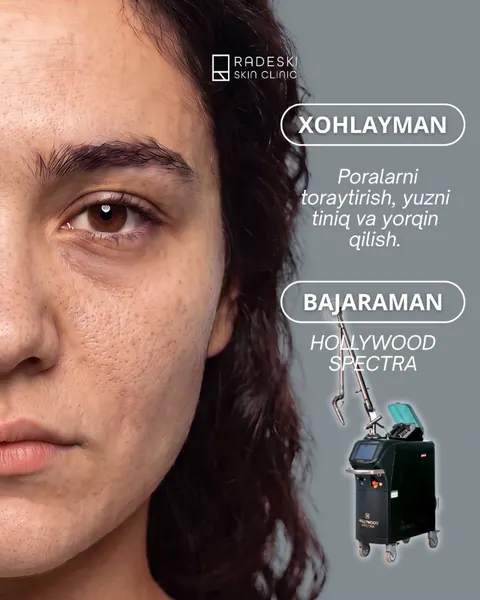
Q-switch laser — carbon peel, gold toning and pigmentation treatment.
Hollywood Spectra is Lutronic's Q-switch laser system for facial cleansing and skin renewal. Protocols include carbon peeling, gold toning and pigmentation treatment. At Radeski Clinic it addresses acne, post-acne redness, pigment spots and dullness.
Hollywood Spectra is a Q-switch laser system by Lutronic. Q-switch technology delivers light in very short (nanosecond-range), powerful pulses. The energy arrives so quickly that pigment particles break apart mainly through a mechanical effect, while the surrounding tissue heats up relatively little.
At Radeski, Hollywood Spectra is used with several protocols: carbon peeling, gold toning and pigmentation treatment. It is used for acne and post-acne marks, pigment spots, enlarged pores and dull, tired-looking skin. The doctor decides which protocol to use based on the condition of the skin.
Like any laser procedure, Hollywood Spectra starts with a dermatologist's examination. Pigment spots are checked with dermatoscopy beforehand: not every dark spot is ordinary pigmentation, and suspicious lesions are not treated with the laser. In severe acne, the laser does not replace medical treatment.
Manufacturer: Lutronic
How does it work?
In a carbon peel, a thin layer of special carbon lotion is applied to the skin. It dries and fills the skin's surface and pores. The laser pulses are absorbed by the carbon particles, which heat up and break apart — taking dead cells and some of the oil in the pores with them. The skin is gently warmed, which may stimulate renewal.
Toning protocols, including gold toning, use low-energy pulses applied in several passes. They act on the pigment in the skin gradually, without visible damage, so results usually build up over several sessions. The doctor chooses the energy, spot size and interval between sessions based on the skin phototype and type of pigmentation.
- Deep cleansing of the skin surface and pores
- Temporarily less oiliness and less visible pores
- Some pigment spots and post-acne marks fading
- A more even skin tone
- Clearer, fresher-looking skin
Indications
Oily skin and enlarged pores
A carbon peel can help clear pores and temporarily reduce oiliness. Many patients notice that their skin feels cleaner and smoother after the very first session, but a more lasting result usually needs several sessions and proper home care.
Acne
In mild to moderate acne, a carbon peel can be used as an add-on to a broader treatment plan: it clears pores and helps reduce oil production. Because acne has different causes, the main treatment is prescribed by a dermatologist. In severe or pustular acne, the laser does not replace medication.
Post-acne marks
The reddish and brown marks left after acne bother many patients. Toning protocols can help gradually fade pigmented marks and even out skin tone. Deep scars (atrophic acne scars) are not the main target of this method — for those the doctor will consider other options.
Pigment spots and melasma
The Q-switch laser can be used to correct sun spots and some other types of pigmentation. Every spot is checked with dermatoscopy beforehand. Melasma is a chronic condition that tends to recur: toning is used for it only at the doctor's discretion, with cautious settings and as part of a combined treatment plan, because sessions that are too frequent or poorly adjusted can lead to uneven changes in skin colour.
Dull skin and uneven texture
When the skin looks dull and tired or has minor irregularities, a carbon peel or toning can give it a clearer, smoother look. The method is often chosen before an important event or as part of regular skincare, but the result is always individual.
Who is it for?
Hollywood Spectra may suit adults who are bothered by oily skin, acne and post-acne marks, pigment spots or dull skin and who want a method with a short recovery. Before choosing the procedure, the doctor assesses:
- Skin type, phototype and any recent tan
- How severe the acne is and whether there is active inflammation
- The type of pigmentation, based on dermatoscopy
- Current medications, especially retinoids
- Previous procedures and how realistic the expectations are
Contraindications
Whether the procedure can be done is decided individually. The main reasons to postpone or avoid Hollywood Spectra are:
- A fresh tan, tanning beds or self-tanner
- Active infections in the treatment area, including a herpes flare-up
- Severe pustular inflammation or open wounds
- Suspicious spots and lesions that have not yet been examined
- Medications and conditions that increase sensitivity to light
- A tattoo or permanent makeup in the treatment area
- Pregnancy and breastfeeding, when elective aesthetic procedures are usually postponed
- Other individual circumstances in which the doctor considers laser treatment unsafe
Systemic retinoids for acne (isotretinoin), a tendency to keloid scarring, dark skin phototypes, melasma and active skin diseases all require a separate risk assessment. In such cases the doctor may postpone the procedure, change the settings or recommend another method.
How we use it at Radeski Clinic
Price list includes Hollywood Spectra for pigmentation and post-acne. Protocol (carbon peel, gold toning) is selected by the physician.
Procedure steps
- Consultation and dermatoscopy: The dermatologist examines the skin, asks about acne, pigmentation and other concerns, and checks pigment spots with a dermatoscope. You will be asked about medications and previous procedures. The doctor then chooses the right protocol — carbon peel, gold toning or pigmentation treatment.
- Skin preparation: The skin is thoroughly cleansed of makeup, cream and oil. If a carbon peel has been chosen, a thin layer of carbon lotion is applied and left to dry for a few minutes. Both patient and doctor wear special protective eyewear.
- Laser treatment: The doctor treats the face in several passes. During a carbon peel you will hear a characteristic crackling and may feel mild warmth and tingling. Toning protocols usually feel even gentler. The procedure is generally done without anesthesia.
- Cleansing and soothing: After a carbon peel, any remaining carbon is washed off. A soothing product and SPF are applied. Mild redness usually fades within a few hours, so most patients return to their usual activities the same day.
- Aftercare and course: For a few days you should avoid harsh scrubs and irritating products and apply SPF daily. A course of several sessions is usually needed; the doctor sets the number of sessions, the intervals and the protocol based on how the skin responds.
Results: what to expect
After a carbon peel the skin often looks cleaner and smoother right away, while results for pigment and post-acne marks build up gradually over several sessions. During the course you may see:
- Cleaner skin and less visible pores
- Less oily shine
- Post-acne marks fading
- Some pigment spots becoming less noticeable and a more even tone
- A fresher, more radiant look
Frequently asked questions
Is a carbon peel painful?
Most patients find a carbon peel easy to tolerate: you will notice crackling sounds, warmth and light tingling. Anesthesia is usually not needed. How it feels depends on the settings and your skin's sensitivity.
How many sessions are needed?
It depends on the goal. Many people notice the cleansing effect after the first session, while acne, post-acne marks and pigmentation usually need a course of several sessions. The doctor sets the number of sessions and the interval between them.
Can I have it done in summer?
If you have a fresh tan, the procedure is usually postponed. If your skin is not tanned and you are ready to use SPF every day and protect yourself strictly from the sun, the doctor may allow it in summer too. Sun protection is especially important when treating pigmentation — without it, the result can be lost quickly.
Will it cure my acne?
No, the laser on its own does not cure acne. A carbon peel helps clear pores and reduce oil production and can be a useful addition to a broader treatment plan. Finding the cause of acne and prescribing the main treatment is the dermatologist's job.
Can I go straight back to work?
In most cases, yes: mild redness usually fades within a few hours. After pigmentation protocols some spots may temporarily darken and then flake off. On the day of treatment avoid hot saunas and intense exercise, and use SPF daily.
Conclusion
Hollywood Spectra (Lutronic) is a Q-switch laser system that combines carbon peeling, gold toning and pigmentation treatment protocols. It can be used for oily skin, acne, post-acne marks, pigment spots and dullness, but results are individual and no method can guarantee them.
At Radeski, Hollywood Spectra treatment starts with a dermatologist consultation: the doctor assesses the skin, checks spots with dermatoscopy, selects the right protocol and sets the number of sessions. If you have acne, the laser procedure is planned together with the main treatment prescribed by the dermatologist.