
After a Hair Transplant: Aftercare from Day One to Month 12 and What Is Normal
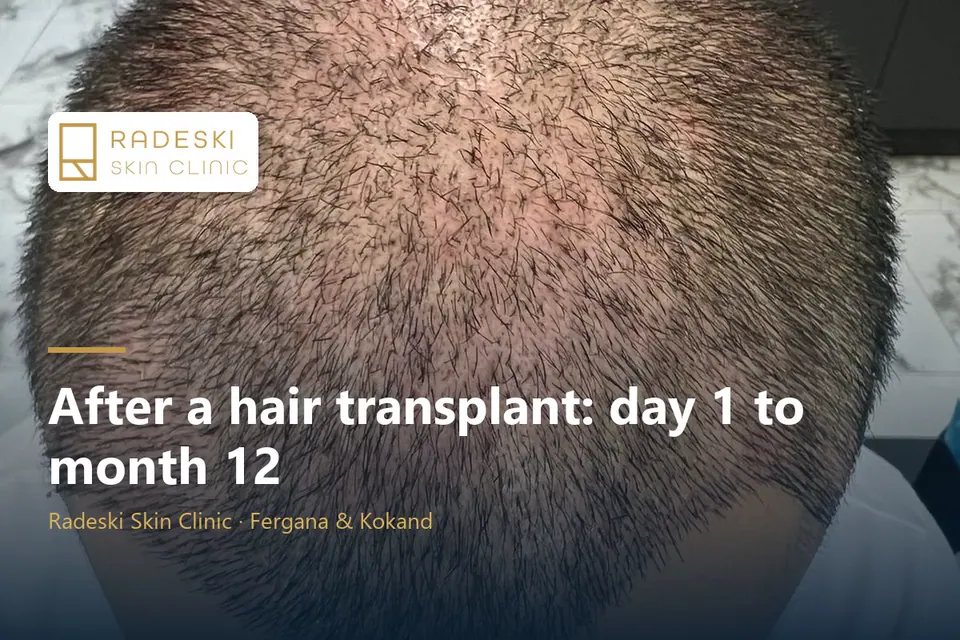
Aftercare after a hair transplant: what is normal from day one to month 12, crusts, shock loss, what to avoid and when to call the doctor.
Key takeaways
- The surgeon’s written instructions always come first
- Do not touch the grafted area or pick the crusts in the first days
- Transplanted hair shedding at weeks 2–8 is normal — the follicle stays
- New hair grows from 3–4 months; the final result is at 9–12 months
- Sauna, pool, sun and intense sport — only once the doctor allows
The result of a hair transplant depends not only on the operation but on the care in the following weeks. Grafts are very fragile in the first days, and then come several months of stages that worry patients but are normal. Below is a typical timeline. The key rule: the written instructions of the surgeon who operated on you always come first — timings differ a little from patient to patient.
The first 3 days
- Do not touch, rub or scratch the grafted area.
- Sleep with your head slightly raised to reduce swelling. Mild swelling of the forehead and around the eyes is possible and usually settles in a few days.
- Avoid bending over, lifting and exercise.
- Take prescribed medicines as directed; do not add any on your own.
Days 4–14: washing and crusts
- The doctor tells you when and how to wash your hair the first time — usually gently, without rubbing, with a special product.
- Small crusts form around the grafts. They usually come off by themselves within 1–2 weeks — do not pick them.
- Mild itching is normal; do not scratch — ask the doctor what helps.
- Wear headwear only when the doctor allows, and choose a loose one.
Weeks 2–8: “shock loss”
This stage worries many people: the transplanted hairs start to fall out. This is normal — the shaft sheds while the follicle stays in the skin and starts a new cycle. Sometimes your own hair in the donor area or nearby thins for a while too.
Months 3–4: new hair
New hair starts to grow — thin and sparse at first. It is still too early to judge the result.
Months 6–12: the final result
The hair thickens and density increases. The final result usually forms by 9–12 months. Radeski follows patients up for 6–12 months after surgery.
What to avoid in the first weeks
- Sauna, steam bath, swimming pool and sea — until the doctor allows.
- Intense sport and heavy sweating — usually for several weeks.
- Sun — keep the grafted area out of direct sunlight.
- Smoking and alcohol — they slow blood flow and healing.
- Hair dye and chemical products — only once agreed with the doctor.
Your own hair needs treatment too
Transplanted hair resists androgenetic loss, but your own hair nearby may keep thinning. That is why the doctor may recommend trichology treatment (such as PRP) after surgery.
Read more: Hair transplant with FUE and DHI, Hair transplant in Fergana, PRP therapy for hair.
When to see a doctor
- Severe pain, redness or pus in the grafted area
- You develop a fever
- Swelling lasts more than a week or gets worse
- A graft site keeps bleeding
- Some areas still show no growth after 12 months
Frequently asked questions
Hashtags
#Hairtransplant#Afterhairtransplant#Aftercare#Shockloss#Trichologist#Fergana#RadeskiSkinClinic
Important note: This article is for general information only and does not replace a medical consultation.
Related clinic services
Videos on this topic
More helpful articles
Hair Loss in Women: Causes, Tests and Treatment — Trichologist Advice
Hair loss in women: after childbirth and telogen effluvium, iron deficiency, thyroid, female pattern thinning. Trichoscopy, tests and treatment. Trichologists in Fergana and Kokand.
Read more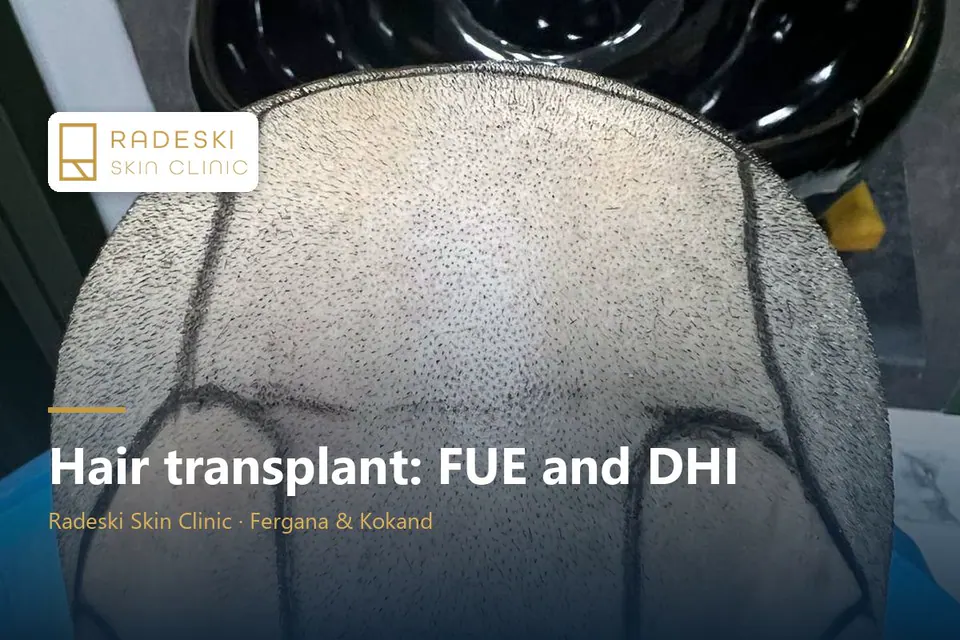
Hair Transplant with FUE and DHI: The Process, Results and What Affects the Price
Hair transplant with FUE and DHI: grafts and the donor area, the steps of the operation, what affects the result and price, and when you see results. Radeski — Fergana.
Read more
Beard and Moustache Transplant: Who It Suits, How It Works and When You See Results
Beard and moustache transplant: who it suits, when to wait, how the operation goes (FUE, DHI), recovery and when results show. Radeski — Fergana.
Read more