
Moles and Dermoscopy: Which Mole Is Dangerous — the ABCDE Rule and Check-ups
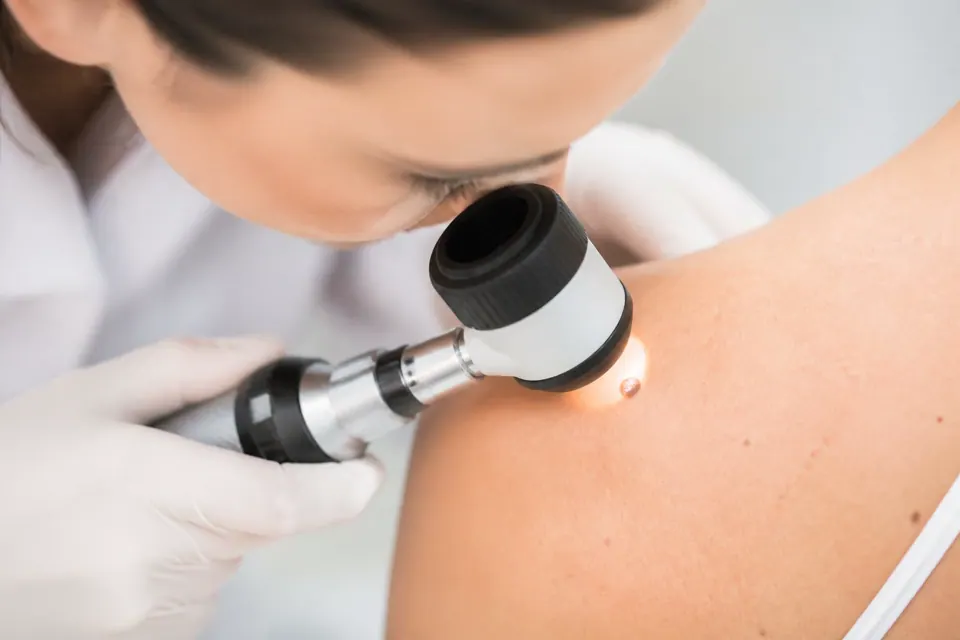
When to check a mole: the ABCDE rule, risk groups, dermoscopy and mole mapping, removal and histology. Dermato-oncologists in Fergana and Kokand.
Key takeaways
- Most moles are harmless, but melanoma often starts as a mole
- ABCDE: asymmetry, irregular border, several colours, over 6 mm, evolving
- Dermoscopy is painless and takes a few minutes
- With many moles, mole mapping catches changes early
- A removed mole is always sent for histology
A mole (naevus) is a cluster of pigment cells in the skin. Almost everyone has a few moles, and most stay harmless for life. But melanoma, the most dangerous skin cancer, often starts as a mole or appears in an existing one. That is why having a mole checked in time is a simple, painless and potentially life-saving step.
When to check a mole: the ABCDE rule
When looking at your moles at home, watch for:
- A — asymmetry: the two halves do not match;
- B — border: ragged, notched or blurred edges;
- C — colour: several colours in one mole — brown, black, red, white or bluish;
- D — diameter: larger than 6 mm (bigger than a pencil eraser);
- E — evolution: the mole changes in size, shape, colour or height.
Also see a dermatologist if a mole itches, bleeds, ulcerates or looks very different from your other moles (the "ugly duckling" sign).
Who should have their moles checked regularly?
- people with more than 50 moles;
- people with fair skin, blond or red hair, who burn easily;
- anyone who had several bad sunburns in childhood;
- people with a family history of melanoma;
- people with large (congenital) or irregular moles;
- sunbed users and people who work outdoors.
What is dermoscopy?
Dermoscopy is examining a mole with a special magnifying instrument (a dermatoscope). The doctor sees the mole's inner structure, pigment pattern and blood vessels — features invisible to the naked eye. It is painless, takes a few minutes and needs no preparation.
People with many moles are advised to have mole mapping (digital dermoscopy): the moles are photographed and compared at the next visit, so even small changes are caught early. At the clinic this is done with the FotoFinder system.
When is a mole removed?
Not every mole needs removing. The doctor recommends removal if:
- dermoscopy shows suspicious features;
- the mole is changing;
- clothing, a belt or shaving keeps injuring it;
- the patient wants it removed for cosmetic reasons.
The removed tissue is sent for histology — the only way to know exactly what the mole is. A suspicious mole must never be burned off without histology: the diagnosis would be lost.
How to protect your moles
- Avoid long sun exposure between 11:00 and 16:00.
- Reapply SPF 30–50 sunscreen every 2 hours.
- Take special care to keep children from getting sunburnt.
- Avoid sunbeds.
- Check your skin once a month, including the scalp, palms, soles and under the nails.
- Never cut, burn or tie off moles yourself.
Mole checks in Fergana and Kokand
At Radeski Skin Clinic a dermato-oncologist examines moles with a dermatoscope, maps them when needed, removes a suspicious mole and sends it for histology.
- Mole check in Fergana;
- Mole check in Kokand;
- Dermoscopy in Fergana and in Kokand;
- in depth: Basal cell carcinoma — skin cancer.
Melanoma found at an early stage can usually be cured. A yearly mole check is the easiest way to make sure it is found early.
When to see a doctor
- A mole changes in size, shape or colour
- A mole itches, bleeds or ulcerates
- A mole has irregular edges or several colours
- A new mole appears in adulthood
- Melanoma runs in the family — once a year
Frequently asked questions
Hashtags
#Moles#Dermoscopy#Melanoma#Moleremoval#Dermatooncologist#Fergana#Kokand#RadeskiSkinClinic
Important note: This article is for general information only and does not replace a medical consultation.
Related clinic services
More helpful articles
Nail Fungus (Onychomycosis): Signs, Causes and Treatment — Podiatrist Advice
Nail fungus (onychomycosis): yellow, thick, crumbling nails. Signs, lab confirmation, podiatric nail care and how long treatment takes. Podiatrists and dermatologists in Fergana and Kokand.
Read more
Skin Allergy and Hives: Symptoms, Causes and Treatment — When to Seek Urgent Help
Skin allergy and hives: itchy welts, redness and swelling. Causes, acute and chronic hives, when to call an ambulance and how it is treated. Dermatologists in Fergana and Kokand.
Read more
Itchy Skin: Causes, Warning Signs and Treatment — Why Your Skin Itches
Why skin itches: dryness, eczema, hives, scabies, fungus and internal causes. Warning signs, what a dermatologist checks and home care. Dermatologists in Fergana and Kokand.
Read more