
Rashes in Children: When to Worry and When to See a Dermatologist

Rashes in children: when to call an ambulance at once (the glass test), the most common causes, mistakes parents make and when to see a paediatric dermatologist. Fergana and Kokand.
Key takeaways
- A rash that does not fade when pressed, plus fever — call 103 at once
- Most childhood rashes are harmless: atopic dermatitis, heat rash, nappy rash, allergy
- Do not use adult or steroid creams on a child on your own
- A rash that lasts 2–3 days or spreads needs a dermatologist
- Take a photo of the rash before the visit
Rashes are very common in children and often worry parents. Most are harmless and clear quickly, but some need a doctor's examination and, rarely, urgent help. This article helps you tell when to worry and when to see a dermatologist.
Call an ambulance right away (103)
Do not wait if:
- a rash does not fade when pressed and your child has a fever. It is easy to check: press a clear glass against the rash — if the spots are still visible through the glass, call 103 at once;
- your child is very floppy, drowsy, irritable or will not stop crying;
- breathing becomes difficult, or the lips, face or tongue swell;
- widespread blisters appear and the skin peels;
- a baby under 3 months has a fever and a rash.
The most common rashes in children
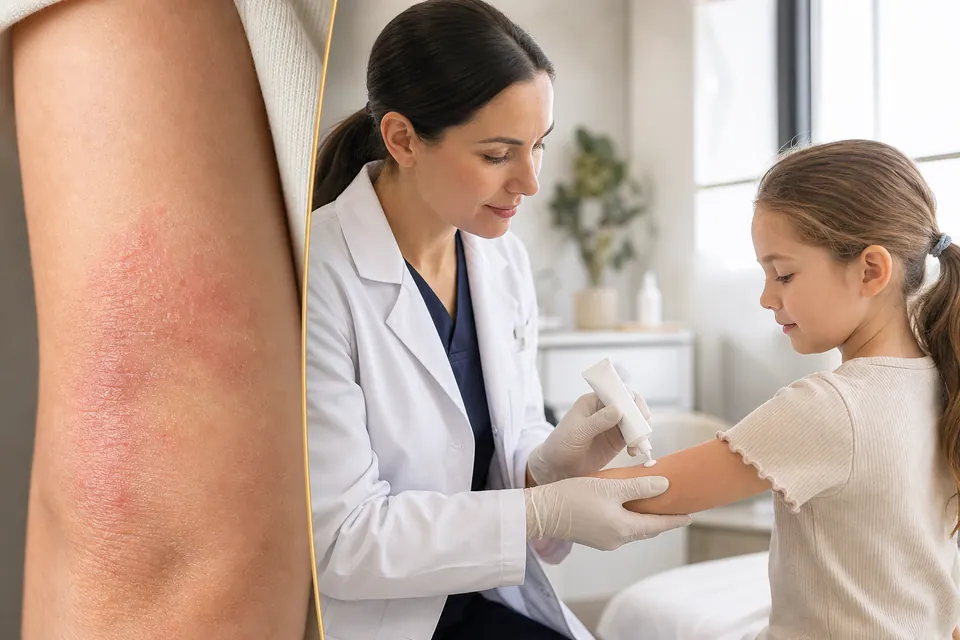
- Atopic dermatitis — dry, red, itchy skin on the cheeks and in the elbow and knee creases. More: atopic dermatitis.
- Hives and allergy — itchy welts that come and go quickly. More: hives and skin allergy.
- Nappy rash — redness under the nappy; frequent changes, nappy-free time and a barrier cream help. Bright redness in the folds with small spots around it may be a yeast infection.
- Heat rash — tiny red spots on the neck, chest and back from overheating; do not over-wrap your child.
- Viral rashes — chickenpox, rubella and other infections, often with fever. Do not pop chickenpox blisters.
- Molluscum contagiosum — small pearly bumps with a dimple in the centre. More: molluscum contagiosum.
- Warts — firm growths on the hands and feet. More: warts in children.
- Scabies — night-time itching, a rash between the fingers, often in the whole family. More: scabies.
- Fungal infection of the skin and scalp — ring-shaped patches or round patches with broken hairs, often from cats and dogs. More: fungal skin infections.
- Cold sores — blisters around the lips. More: herpes.
What parents should not do
- Do not use adult creams and medicines on a child.
- Do not use steroid cream on your own — especially on the face and under the nappy.
- Do not paint a widespread rash with iodine, brilliant green or alcohol: they burn the skin and make it harder for the doctor to see the rash.
- Do not pop blisters or pick crusts; keep your child's nails short.
- Before sending a child with a rash to nursery, find out whether it is contagious.
When to see a doctor
- the rash does not clear in 2–3 days or spreads;
- severe itching disturbs sleep;
- the rash weeps, oozes pus or hurts;
- other family members have a similar rash;
- the rash is linked to a new food or medicine.
Before the visit, take a photo of the rash — some rashes fade quickly.
Paediatric dermatologist in Fergana and Kokand
At Radeski Skin Clinic a paediatric dermatologist examines the rash, performs dermoscopy and a scraping when needed, and chooses treatment and care suited to the child's age.
A child's skin is thinner and more sensitive than an adult's: show a rash to a doctor before trying to "treat" it yourself.
When to see a doctor
- A rash that does not fade when pressed, with fever — call 103
- The rash lasts more than 2–3 days or spreads
- Itching disturbs sleep
- The rash weeps, oozes pus or hurts
- Other family members have a similar rash
Frequently asked questions
Hashtags
#Rashinchildren#Paediatricdermatologist#Nappyrash#Atopicdermatitis#Allergy#Fergana#Kokand#RadeskiSkinClinic
Important note: This article is for general information only and does not replace a medical consultation.
Related clinic services
More helpful articles
Atopic Dermatitis: Symptoms, Causes, and Modern Treatment
Atopic dermatitis is a chronic inflammatory skin condition marked by dryness, itching, and rashes. Learn about causes, symptoms, diagnosis, and modern treatment approaches.
Read more
Scabies: Night-Time Itching, How It Spreads and Treating the Whole Family
Scabies: itching that is worse at night, how it spreads, signs, dermoscopy, treating the whole household on one day and cleaning bedding. Dermatovenereologists in Fergana and Kokand.
Read more
Fungal Skin Infections: Feet, Body and Groin — Signs, Testing and Treatment
Fungal skin infections: feet, body, groin, scalp, pityriasis versicolor and candida. Signs, the skin scraping test, the steroid cream mistake, treatment and prevention. Dermatologists in Fergana and Kokand.
Read more