
Vitiligo: White Patches on the Skin — First Signs, Causes and What to Do
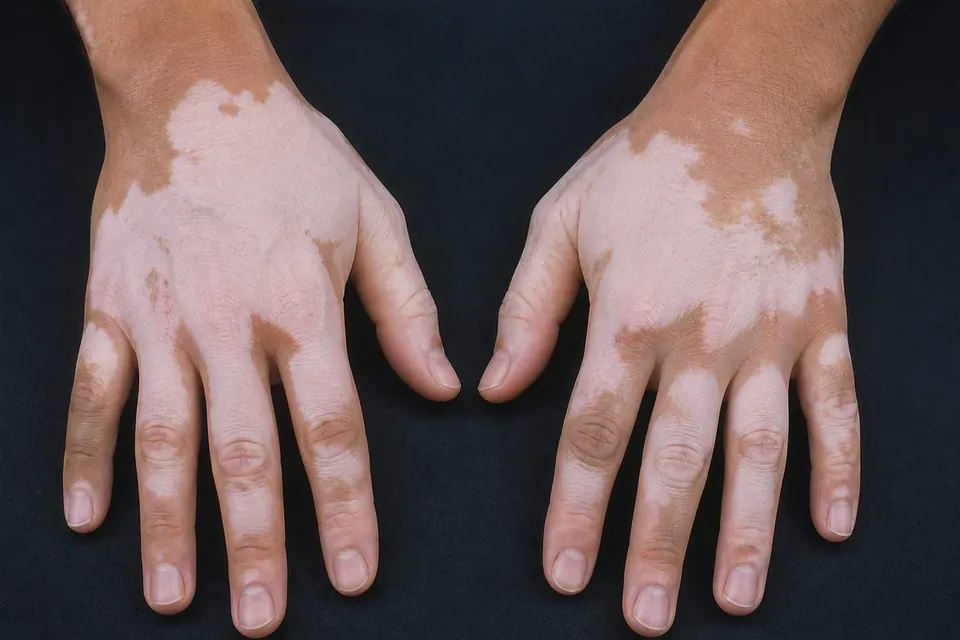
Vitiligo — milky-white patches on the skin: is it contagious or inherited, first signs, look-alikes, what not to do and treatment options. Dermatologists in Fergana and Kokand.
Key takeaways
- Vitiligo is an autoimmune loss of pigment cells and is not contagious
- A tendency can run in families, but that does not mean it will be passed on
- Not every white patch is vitiligo: an exam tells it apart from fungus and pityriasis alba
- Stress, skin injuries and sunburn can trigger new patches
- The doctor chooses the treatment; results come gradually over months and vary between people
Vitiligo is a long-term condition in which patches of skin lose their colour and turn milky white. It can start at any age, most often in childhood or young adulthood. Vitiligo does not hurt and is not life-threatening, but patches on the face and hands are visible and can be very upsetting. Here is how to recognise it, what it can be confused with and when to see a doctor.
What is vitiligo?
Skin colour comes from melanocytes — cells that make the pigment melanin. In vitiligo these cells stop working or disappear. Current understanding is that the main cause is autoimmune: the immune system mistakenly attacks the body's own pigment cells. That is why vitiligo sometimes occurs together with other autoimmune conditions, such as thyroid disease, and the doctor may suggest extra blood tests.
Is it contagious? Is it inherited?
- It is not contagious. Vitiligo does not spread through handshakes, shared dishes, water or air. Living and working alongside someone with vitiligo is safe.
- A tendency can run in families. If relatives have vitiligo the chance is somewhat higher, but that does not mean it will definitely appear.
First signs
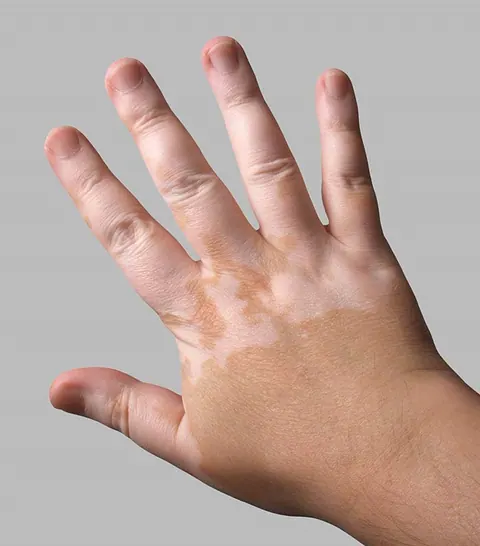
- milky-white or pale patches with clear edges; the skin stays soft, does not itch or flake;
- most often on the fingers and backs of the hands, the face, around the mouth and eyes, on the elbows and knees;
- white hairs, eyebrows or eyelashes inside a patch;
- patches stand out more in summer: the skin around them tans, the patch does not and burns easily.
What can vitiligo be confused with?
Not every white patch is vitiligo. The most common look-alikes:
- pityriasis versicolor — pale or brownish patches with fine scale, caused by a yeast; more: skin fungus;
- post-inflammatory white spots — pale areas left after eczema, a rash or a burn; they usually recover with time;
- pityriasis alba — faint pale patches with blurred edges on children's faces, often on dry skin; more: rashes in children.
Each needs completely different treatment. So the dermatologist may look at the skin under a Wood's lamp (a special ultraviolet light): a vitiligo patch looks bright white, while a fungal patch usually shows a different tint. Dermatoscopy magnifies the edges of the patch and the hairs in it; more on the method: dermatoscopy. If needed, a skin scraping for fungus or blood tests are ordered.
What triggers it?
- severe stress and emotional strain;
- skin injuries — cuts, scratches, friction, pressure from tight clothing: a new patch often appears exactly where the skin was hurt (the Koebner phenomenon);
- sunburn.
Stable and active vitiligo
The stage of the disease matters to the doctor. In active vitiligo new patches have appeared in recent months, old ones are growing and their edges are blurring. In stable vitiligo patches stay unchanged for a long time. Treatment is chosen accordingly, so photographing the patches now and then helps.
When to see a doctor
If a white patch appears, see a dermatologist as early as you can. Do not wait at all if:
- new patches are appearing quickly or growing;
- patches are on the face, around the eyes or lips, or on a child;
- a patch itches, flakes, turns red or thickens — it may be a different disease;
- blisters form on a white patch after sun exposure;
- a mole surrounded by a white ring, or a growth next to a patch, changes, enlarges or bleeds.
What not to do at home
- folk remedies: herbs, vinegar, garlic and other "burning" treatments — a burn triggers new patches;
- lying in the sun or using tanning beds on purpose to "darken" the patches;
- using creams and ointments the doctor did not prescribe, especially steroid ones, on your own for a long time;
- scratching or rubbing the patches hard.
How is it treated at the clinic?
The doctor chooses the method based on the location and size of the patches, disease activity and age:
- narrow-band UVB phototherapy — in Daavlin cabins for widespread patches, on targeted devices for small areas;
- local treatment — products prescribed by the doctor, often combined with phototherapy.
How sessions go and what equipment is used: vitiligo treatment with Daavlin phototherapy.
Results come gradually: colour usually returns as small dots inside the patch or from its edges, and this takes months. The face and neck usually respond better, fingertips more slowly. Results differ from person to person, so patience and regular contact with the doctor matter. General information on the condition: vitiligo.
Everyday care and sun protection
- White patches burn easily: use a high-protection sunscreen on exposed skin, and wear covering clothes and a hat in summer.
- Make sure tight clothing, belts and watches do not rub the skin.
- Cosmetic camouflage products can hide patches temporarily — choose them together with the doctor.
The emotional side
Vitiligo is often hard emotionally: embarrassment, avoiding people, anxiety. These feelings are natural. Talk to loved ones and explain to a child that the condition is not contagious and makes them no less than anyone else. If low mood lasts, do not hesitate to see a psychologist.
Vitiligo diagnosis and treatment in Fergana and Kokand
At Radeski Skin Clinic a dermatologist examines the white patches, tells vitiligo apart from look-alikes and draws up a treatment plan.
- Vitiligo treatment in Fergana and in Kokand;
- Dermatologist in Fergana and in Kokand;
- Phototherapy and Daavlin NeoLux.
The earlier a white patch is shown to a doctor, the more treatment options there are.
When to see a doctor
- A milky-white patch appears on the skin for the first time
- New patches are appearing quickly or growing
- A white patch appears on a child
- A white patch itches, flakes or turns red
- A mole with a white ring, or a growth next to a patch, changes or bleeds
Frequently asked questions
Hashtags
#Vitiligo#Whitepatchesonskin#Lossofpigment#Dermatologist#Phototherapy#Fergana#Kokand#RadeskiSkinClinic
Important note: This article is for general information only and does not replace a medical consultation.
Related clinic services
Videos on this topic
More helpful articles
Vitiligo Treatment at Radeski Skin Clinic: Daavlin Phototherapy — a Global Standard of Care
Vitiligo care at Radeski Skin Clinic: Daavlin narrow-band UVB (311–312 nm) for Fergana and Kokand patients — why it is the gold standard.
Read more
Eczema: Types, Causes and Treatment — Red, Weeping and Itchy Skin
Eczema: redness, blisters, weeping and intense itching. Types, causes, how it differs from psoriasis and fungus, treatment and winter hand care. Dermatologists in Fergana and Kokand.
Read more
Psoriasis: Symptoms, Diagnosis and Treatment
How psoriasis is diagnosed and treated: main signs, dermatoscopy and severity scoring, topical therapy, Daavlin narrowband UVB 311 nm, excimer laser and biologic therapy. Fergana and Kokand.
Read more