
Melanoma: Early Signs, Risk Factors and Why You Should Not Wait
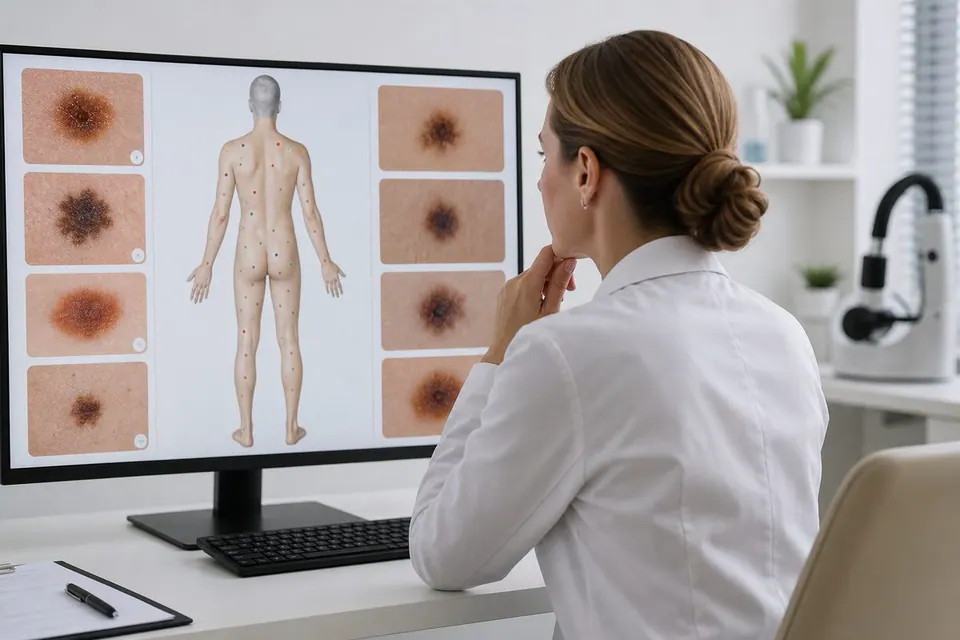
Melanoma — the most dangerous skin tumour: early signs, nail and sole melanoma, risk factors, what not to do and how it is diagnosed. Dermato-oncologists in Fergana and Kokand.
Key takeaways
- Melanoma more often starts as a new spot, but can also develop from an existing mole
- A new, changing or "ugly duckling" spot is a reason to get checked
- A widening dark streak on a nail or a dark patch on the sole can also be melanoma
- Salon cauterising and folk remedies destroy the chance of a diagnosis
- Histology makes the diagnosis; an oncologist decides the stage and treatment plan
Melanoma is a skin cancer that develops from pigment cells (melanocytes). It is the most dangerous skin cancer because it tends to spread to other organs — yet it starts on the surface of the skin, in plain sight, so it can be spotted early. This article is about melanoma itself; routine mole checks are covered separately: moles and dermoscopy.
What is melanoma?
Melanoma can grow out of an existing mole or appear on clear skin as a new spot — and more often it is a new spot. It can occur anywhere: the back, legs, scalp, palms and soles, under a nail and even on mucous membranes.
Early signs
- ABCDE — asymmetry, an irregular border, several colours, a diameter over 6 mm and, most importantly, evolution (change). Each letter is explained in the mole-check article.
- The "ugly duckling" — one spot that looks different from all your other moles.
- A new or changing spot — especially after the age of 30, or one that has grown, darkened or become raised over weeks or months.
- A fast-growing bump — some melanomas do not fit ABCDE at all: a symmetrical, evenly coloured black, red or even skin-coloured firm bump that grows within weeks.
- Itching, bleeding, a sore — the surface of the spot crusts over and starts to bleed on its own.
Melanoma of the nail and sole
Here melanoma is often found late, because people take it for a bruise or fungus.
- On a nail — a brown or black streak along the nail that slowly widens, especially if the pigment spreads onto the skin around the nail. Bleeding under the nail after an injury moves forward as the nail grows; melanoma stays in place. More: nail colour changes.
- On the sole or palm — an irregular brown or black patch, a "wound" that does not heal, or a dark area inside a "callus".
Risk factors
- sunburns, especially blistering burns in childhood and adolescence;
- tanning beds;
- many moles (more than 50) or atypical — irregular, large — moles;
- a large congenital mole;
- melanoma in the family;
- fair skin, light eyes, red or blond hair, freckles, burning easily in the sun;
- a previous melanoma or other skin cancer;
- treatment that suppresses the immune system.
Melanoma can also occur in people with no risk factors, so any changing spot should be checked.
Why does early detection matter so much?
At first, melanoma grows in the top layer of the skin, where it is usually removed with a relatively small operation. Over time it grows deeper and may spread to the lymph nodes and internal organs — and treatment becomes much more complex. That is why "I will wait and see" is the most dangerous decision. If a spot bleeds, ulcerates, grows quickly or new dark dots appear next to it, get it checked as soon as possible.
What not to do
- Have a suspicious mole cauterised at a beauty salon or "removed with a laser" — the tumour may not be removed completely and, above all, no tissue is left for histology, so the diagnosis is lost.
- Folk remedies — vinegar, garlic, plant juices, acids or tying the mole off with thread. They burn the skin, and the scar hides the tumour and delays the diagnosis.
- Cut, prick or wait — early melanoma usually does not hurt, so "it does not hurt" means nothing.
How does a dermato-oncologist check?
- A conversation and a full-body skin exam — including the scalp, palms, soles, nails and the skin between the toes.
- Dermoscopy — a painless, few-minute look at the spot's structure and vessels under magnification.
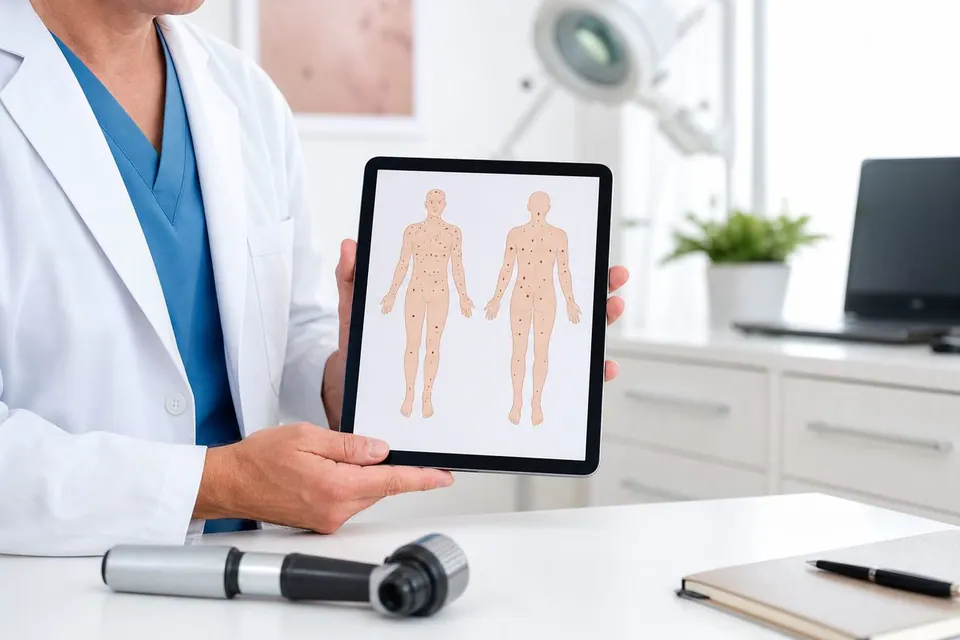
- Total-body mapping (PhotoFinder) — for people with many moles or risk factors, the skin is photographed and compared at the next visit, so a new or changed spot shows up early. More: PhotoFinder diagnostics.
- Biopsy and histology — a suspicious spot is usually removed whole with a small margin of healthy skin, and the tissue is examined under a microscope. Only histology gives a definite diagnosis. More: skin biopsy.
Treatment
The main treatment for melanoma is surgical removal of the tumour by a specialist. The extent of surgery depends on the histology result, such as the tumour's thickness. The stage, and whether further tests or treatment are needed, is decided by an oncologist individually. After treatment the skin stays under regular follow-up.
Some growths look like melanoma but are harmless — for example, seborrheic keratosis. Telling them apart is the doctor's job.
Prevention
- Do not get sunburnt: stay in the shade from 11:00 to 16:00, wear a hat and covering clothes, and reapply sunscreen.
- Give up tanning beds and protect children from sunburn above all.
- Once a month, check all your skin with a mirror; ask someone close to check your back and scalp.
- If you have risk factors, have check-ups as often as your doctor advises.
Melanoma checks in Fergana and Kokand
At Radeski Skin Clinic a dermato-oncologist examines suspicious spots with a dermatoscope, performs total-body mapping when needed and arranges biopsy and histology. One of the methods for removing skin tumours is Mohs micrographic surgery; the doctor decides which method suits each case.
- Dermato-oncologist in Fergana and in Kokand;
- Dermoscopy in Fergana and in Kokand;
- Mole check in Fergana and in Kokand;
- Skin biopsy in Fergana and in Kokand.
Do not keep watching a changing spot on your own — showing it to a dermato-oncologist takes minutes, while delay can cost a great deal.
When to see a doctor
- A new spot appears, or a mole grows, darkens or changes shape
- A mole or spot bleeds, ulcerates or crusts
- A firm bump appears and grows within weeks
- A dark streak on a nail widens, or an irregular dark patch appears on the sole
- Melanoma runs in your family or you have a great many moles
Frequently asked questions
Hashtags
#Melanoma#Skincancer#Uglyducklingsign#Dermatooncologist#PhotoFinder#Fergana#Kokand#RadeskiSkinClinic
Important note: This article is for general information only and does not replace a medical consultation.
Related clinic services
Videos on this topic
More helpful articles
Actinic Keratosis: Rough Sun Spots — Why They Matter and How They Are Treated
Actinic keratosis — rough, scaly spots on sun-damaged skin: why it is precancerous, how it differs from other spots, red flags, diagnosis and treatment. Oncodermatologists in Fergana and Kokand.
Read more
Basal Cell Carcinoma (Basalioma): Symptoms, Causes, and Treatment
Basal cell carcinoma (basalioma): how it looks, why it develops, when to see a doctor, and how it is treated — a practical guide from Radeski Skin Clinic.
Read more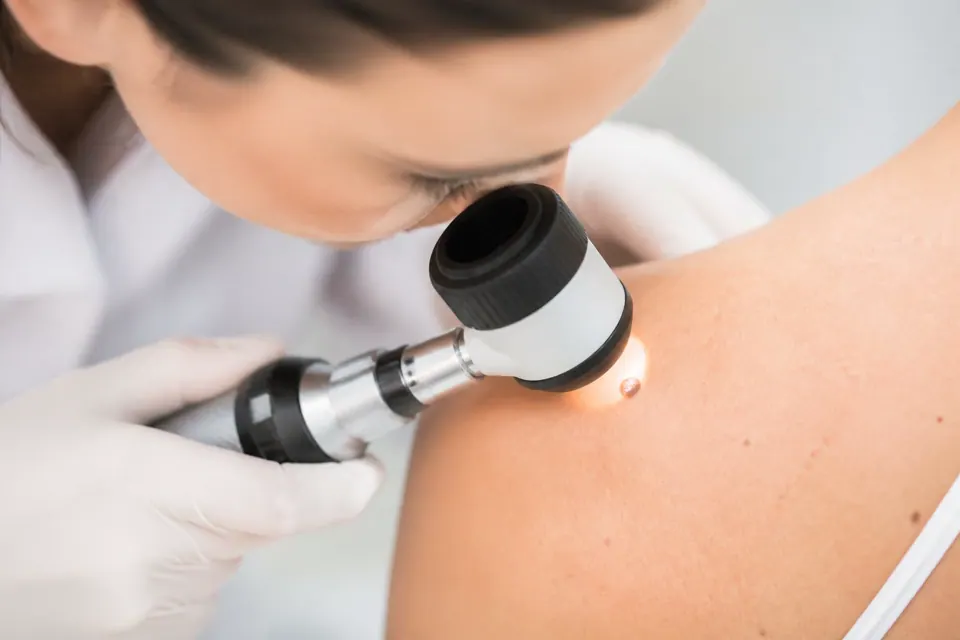
Moles and Dermoscopy: Which Mole Is Dangerous — the ABCDE Rule and Check-ups
When to check a mole: the ABCDE rule, risk groups, dermoscopy and mole mapping, removal and histology. Dermato-oncologists in Fergana and Kokand.
Read more